
From a Māori wharenui in New Zealand to a Mennonite opera gala in Pennsylvania, group singing creates spaces of belonging and connection. This is a call to keep those spaces alive.
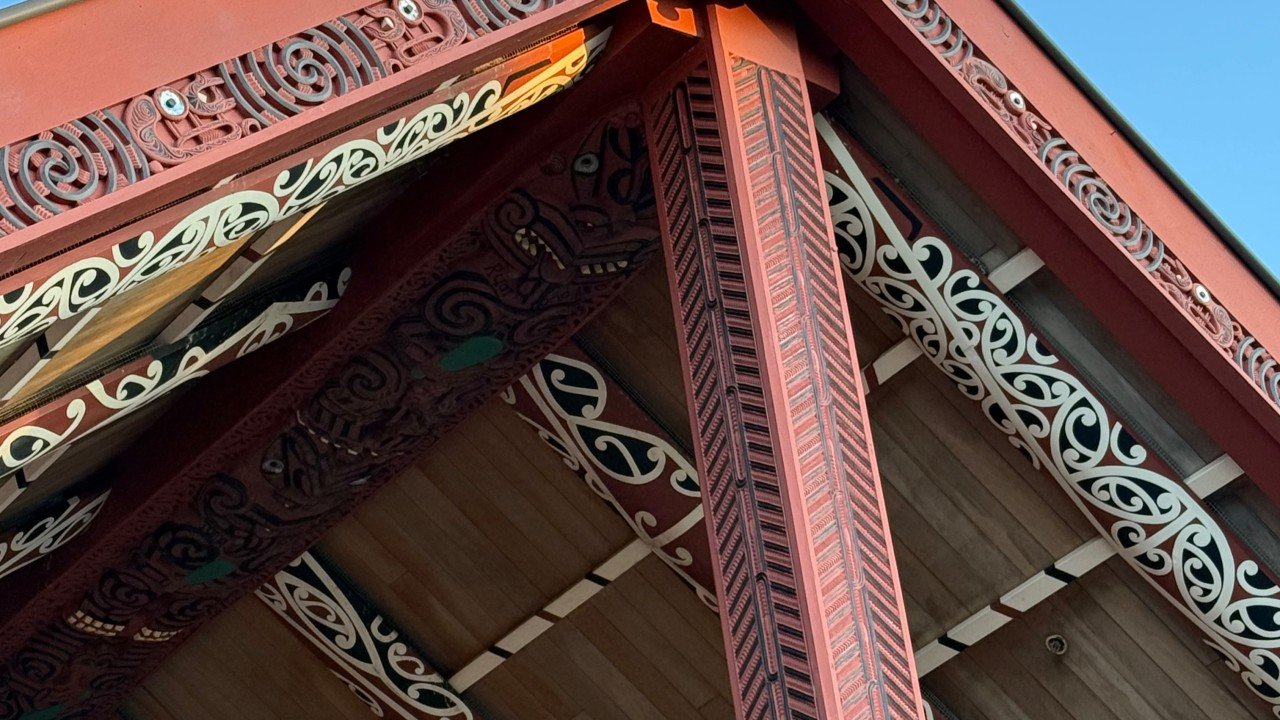
Last month, I attended the debut of The Journey of Mataatua Whare: The House that Came Home, by composer Dame Gillian Karawe Whitehead in Whakatāne, New Zealand. My husband, New Zealand bass baritone Paul Whelan, was cast as a soloist. The piece wove together history, culture, and music—telling the story of Mataatua Wharenui, a carved ancestral house taken from the Ngāti Awa people. The house was displayed overseas in Sydney, Melbourne, and London where it was packed away in a museum basement for over 40 years. It was finally returned home in 2016, after generations of separation. The Journey of Mataatua Whare’s four movements, featuring three soloists, choir, orchestra, with projected images of historical photos and letters, recounts a tale of cultural loss, resilience, and return.
The first performance of the piece was held within the actual wharenui (carved ancestral house), attended by invited guests, Māori elders, and other community members with a deep cultural connection to the story of Mataatua. (A subsequent performance was held in the Dunedin Town Hall for a larger public audience).
The piece was meant to conclude with a video of Māori women singing a traditional song. Due to a technical glitch, the planned video played but there was no sound. For several seconds, there was awkward confusion in the audience—then some murmuring—and something extraordinary: the audience burst into song. They recognized the song from the traditional hand gestures in the video. Voices, young and joined in harmony to fill that historic, sacred space – a stunning moment of living tradition.
Though I was literally on the other side of the world from where I grew up—in a Mennonite community in Harrisonburg, Virginia—that moment felt like home. In my childhood, communal acapella four-part singing was woven into everyday life. I have no memory of learning these hymns; we simply grew up knowing them. By the time conscious memory formed, they were already hardwired—like knowing how to walk or knowing what your name is.
In fact, that dramatic moment of group singing in Whakatāne reminded me of similar moments from my own tradition. From 2008 to 2018, my friend Tim Long and I produced an annual opera gala called Voices of Hope in Lancaster, PA. These concerts featured world-class operatic talents such as Erin Morley, Samantha Hanley, Jennifer Johnson Cano, among others—all generously performing to raise funds for a Mennonite education charity. At the end of each concert, we would invite the audience—mostly progressive Mennonites—to “give something back” by singing together for our guest artists. Without sheet music or rehearsal, hundreds lifted their voices singing the beloved hymn affectionately known as the “Mennonite national anthem.” The surprise of that impromptu performance by our audience was so powerful it moved some of our guest artists to tears.
The value of community singing isn’t limited to such “dramatic” moments, though. My father, who sang heartily from the audience at those Voices of Hope concerts, passed away recently after a years-long struggle with dementia. In his final months, even when he could no longer remember the word for “lemon” or “banana,” he could still sing every note of that “Mennonite national anthem.” Songs of the Mennonite tradition became a way to connect—to him, to our history, and to each other.
Yet as our societies become more modern, secular, and global, opportunities for communal singing are growing increasingly rare. While not all of these cultural shifts are inherently negative, these traditions–like creatures on an endangered species list—stand on the brink of extinction.Without them, we risk losing a vital connection to each other, and our deepest selves.
At a time when loneliness is an epidemic, when our society grows ever more fractured and divisive, we as artists need to lead the way, finding relevant ways to carry these essential practices forward. It is up to us to seek out new ways to incorporate and welcome group music making into our programming and practice.
That’s why I’m so inspired by Timothy Long 's current work with the North American Indigenous Song Book as founder for the Plimpton Foundation, Tim is shining a light on Native American song traditions while also uplifting new Native American composers—knitting tradition and innovation together in one beautiful, revolutionary stroke. His work reminds us that in order for traditions to survive, we must adapt. Tradition and innovation can—and must—coexist.
At Creative Stage Collective and Creative Stage, we are also exploring what it means to make music as a community in the modern age. With a mission to create and perform across cultures and generations our multigenerational collective is a powerful tool for community-building. Our collaborative process brings youth and professional artists together in joyful, imaginative performances—where singing and storytelling become shared acts.
Group singing is vital – it's something we are not meant simply to listen to, it is something we are meant to do. Together.
Whether in New Zealand at The House That Came Home, at Voices of Hope concerts in Lancaster, or through the Plimpton Foundation’s work with First Nations artists, these shared musical moments remind us of who we are, and lead us back to each other.
If you have memories of group singing, or know of ways that other arts organizations are adapting to make space for this practice, I’d love to hear from you.