
From NYT Opinion A.I. Will Destroy Critical Thinking in K-12: “If A.I. is carelessly incorporated all the way down to pre-K, it will be a horrible mistake. It could inhibit children’s critical thinking and literacy skills and damage their trust in the learning process and in one another. As my newsroom colleagues reported last week in “A.I. Is Getting More Powerful, but Its Hallucinations Are Getting Worse,” the hallucinations may always exist. But even more to the point, when we automate the most connective human tasks, like teaching, and relegate that to systems that can get basic facts wrong, it can lead to rot all the way down.”
When I think seriously about AI in education, I find I have to go back to the fundamental question: What is the actual goal of K-12 education? What are we really trying to achieve?
I grew up debating this very question around the dinner table with my father—a gifted, lifelong educator—my mother (also a teacher), and my two sisters. If you’d been a guest at those dinnertime conversations—lucky you, my mother was a famously wonderful cook—you’d know I fall firmly in the camp that believes the purpose of education is to equip students with the skills they need to learn how to learn.The goal is to nurture curiosity, resilience, and a deeper understanding of the real, human world we live in.
Ask anyone what they learned in school. Assuming they are over the age of 18, I guarantee they won’t recite a vocabulary list, give you the capital of Rhode Island, or proudly recite pi. They’ll tell you about a history project they worked on that was a triumph..or a flop, the field trip to D.C. where their friend threw up on the bus, their epic battle for first place in the science fair (anyone else remember the potato battery?). They'll probably tell you about their role as Second Sunflower in the school play, or playing in a rock band, or how their elderly piano teacher had bad breath.That’s because people learn best through experiences and interactions with other humans IRL.
This is where arts education—particularly theater—and AI radically diverge. AI can simulate dialogue, generate scripts, even offer coaching. But it cannot place you on a stage, or give you a scene partner. It cannot teach you to read a room, improvise with your team, or capture the magical, visceral sensation of singing in harmony with a room full of others. It can’t teach you how to be human.
It takes a human to teach another human to be human.
Artificial Intelligence isn’t the first technology we’ve had to grapple with in education. When I was in school in the 80s, it was Texas Instruments computers and rudimentary coding classes. Since then, we’ve cycled through new hardware and platforms—iPads, smartphones, Zoom classrooms. The core philosophical question remains: What are we trying to achieve?
At Creative Stage Education Company and in our multigenerational Creative Stage Collective (CSC) theater troupe, we use the performing arts to do just that. When kids engage in improv, and music making, they practice taking creative risks, adapting in real time, and learn to navigate the social emotional landscape of collaborating with others. Study after study shows that this kind of play strengthens emotional intelligence and prepares young people to handle the unpredictable. Music is the other cornerstone of our work, and its benefits are equally profound. Students who study music in a meaningful, sustained way consistently show stronger academic outcomes and cognitive flexibility. These are more than performance skills—they’re life skills.
Why does studying the performing arts yield such consistently impressive results? One key reason is that it immerses students in the full spectrum of experience—including the moments that are hard, messy, or even uncomfortable.
I often tell parents (and remind myself) that even a tough experience can be a meaningful one. If your child goes to camp and hates it, that doesn’t mean the week was a failure. While we’d never intentionally seek out unhappy experiences for our kids, the truth is—hard moments are inevitable. And often, they’re powerful teachers. Disappointment builds resilience. Frustration builds problem-solving. A little struggle today can create the skills that unlock more joyful, confident experiences tomorrow.
But mostly—let’s be honest—the performing arts are fun. So wonderfully, wildly fun. And that’s what makes this next part so bewildering.
Study after study shows that participation in music and theater boosts academic performance, supports emotional growth, and builds essential social skills.
So why, when the research is so clear, do we so often see kids pulled from a favorite theater class for math tutoring or remedial reading? Why do we cut arts funding while clinging to the “STEAM” acronym? Think about it: to perform a play, kids must read, memorize, comprehend, and recite lines—it's intensive literacy work, with full buy-in from the child. The alternative? Sitting at a screen, clicking through multiple-choice drills.
I sometimes wonder if we’re all operating under a kind of collective insecurity—some deep-rooted cultural belief that if something feels joyful, it must not be serious or valuable. That if our kids are having fun, they can’t possibly be learning.
But that couldn’t be further from the truth.
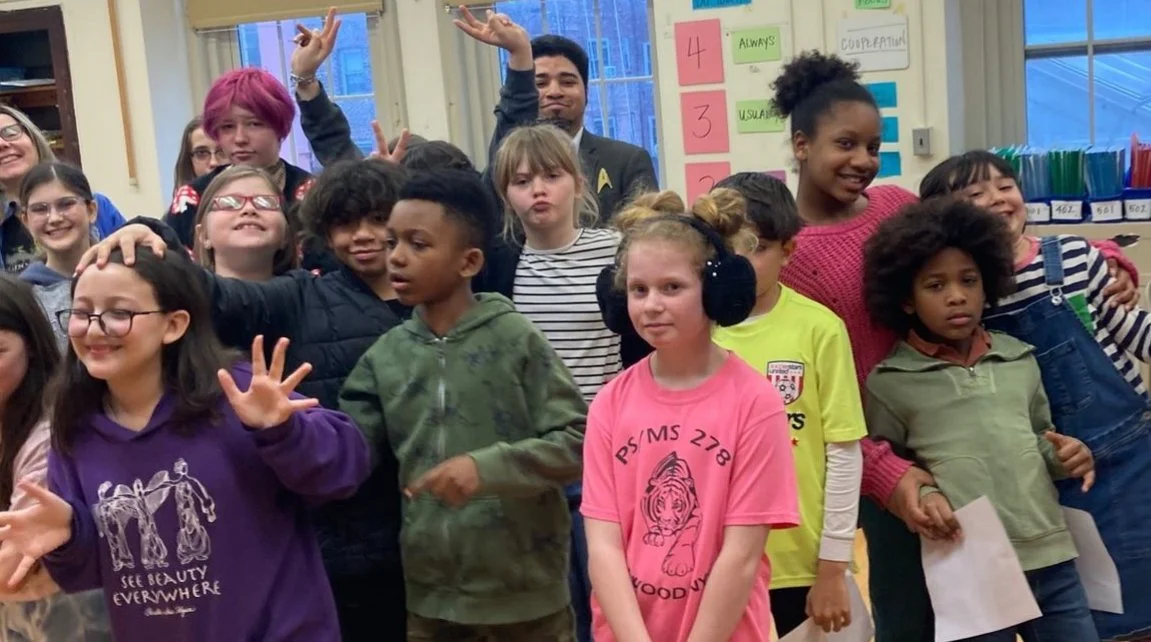
We recently held an open day with our CSC teen troupe and played one of our classics: the spoof commercial challenge. Each group had to invent a completely ridiculously useless product—say, a bike made of macaroni—and pitch it convincingly. At any given moment, you could look around that room of 7- to 17-year-olds and not see a single phone out. Every kid was locked in: solving problems in multigenerational groups, collaborating, laughing, experimenting, and building something together. In other words: learning.
In that room, we were living the mission of Creative Stage Collective. It was buzzing with creativity and collaboration between kids of different age groups and adults who were all engaged in figuring out a solution, they were talking and listening to each other, and leaping off each other’s ideas. (But don’t take my word for it–here is a link to a CSC instagram post of video from the event)
That’s the kind of experiential learning that sticks.
So, getting back to AI – does it have a place in education? Probably. Just as calculators, spell check, and Google have all become tools in the classroom, AI is becoming a powerful resource. But tools don’t replace human teachers. They don’t replace theater as a teacher. And they won’t replace the deeply human experience of learning through doing.
There is a quote attribute to Benjamin Franklin:"Tell me and I forget. Teach me and I remember. Involve me and I will learn."